G is for Gas: what actually makes food windy
By Mira Sefton · 16 June 2026 · 4 min read
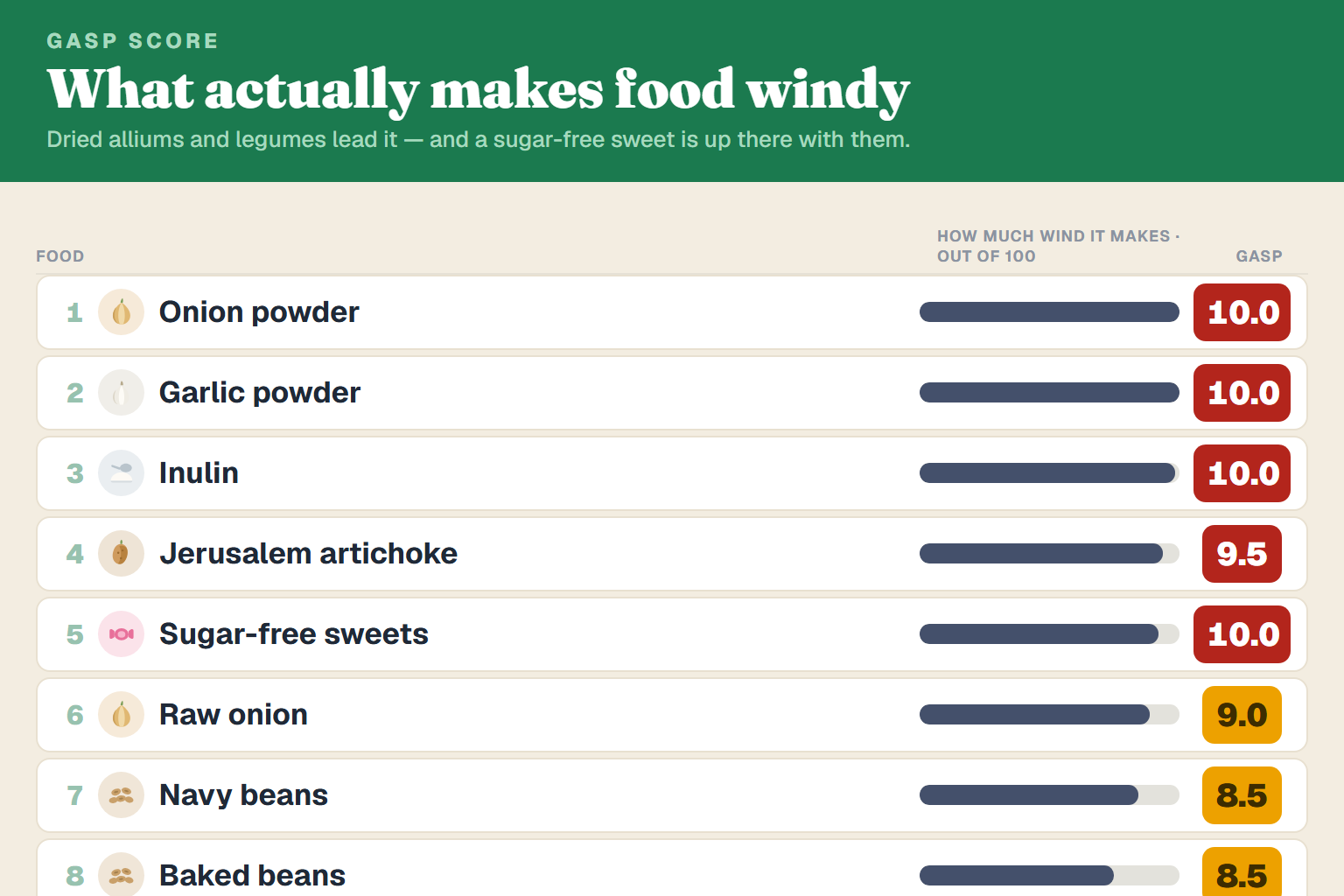
You've eaten something perfectly ordinary, and an hour later your gut sounds like a kettle coming to the boil. The Gas part of our GASP score is trying to predict exactly that feeling — how much wind and bloating a food tends to stir up.
Here's the short version of where wind comes from, and what you can do about it.
Wind is mostly fermentation
Most everyday wind isn't air you swallowed. It's gas made inside you.
Your small intestine absorbs a lot of what you eat, but it can't fully break down certain carbs. Those carbs travel further down to where your gut bacteria live, and the bacteria ferment them. Fermentation makes gas. More fermentable carb in, more gas out.
The usual suspects have a group name: FODMAPs — fermentable carbs that your small intestine often struggles to absorb. The main ones for wind are:
- Fructans — a carb that ferments quickly, found in wheat, onion and garlic.
- GOS (galacto-oligosaccharides) — the famous reason beans and lentils get talked about.
- Excess fructose — when a food has more fructose than glucose, like honey or some apples and mango.
- Sugar alcohols — sorbitol and mannitol, in stone fruit, mushrooms, and a lot of sugar-free gum and lollies.
The evidence linking these to gas and bloating is strong. They're the first thing worth looking at when a meal blows you up.
Some fibres add to it
Fibre isn't one thing. Rapidly fermentable fibres — inulin (often added to "high-fibre" bars and yoghurts), and the soluble fibre in beans — feed the bacteria fast, so they make more gas in a short window.
Gentler, slower fibres tend to pass through with less drama. This is why two foods with the same fibre number on the label can feel completely different.
Sulphur makes wind smelly, not bigger
This trips a lot of people up. Cabbage, broccoli, cauliflower and eggs are rich in sulphur. Sulphur is what turns wind eggy and loud-in-the-room — the odour, not the volume.
So a small serve of broccoli might not bloat you much at all, yet still clear a room. That's a different problem from a big plate of pasta that leaves you genuinely distended. Worth knowing which one you're actually dealing with.
Concentration is the sneaky bit
A teaspoon of onion or garlic powder can hit harder than a slice of the fresh thing. Drying and grinding removes the water and packs the fructans into a tiny serve, and that powder hides in stock cubes, gravy, crisps and most pre-made sauces.
So when something surprises you, check the seasoning, not just the obvious ingredients. The dose is doing the work.
Gentler moves people often try
None of these is a rule. Everyone's gut is different, and what your gut tolerates can shift over months. But these are the things people tell us help:
- Smaller serves. Fermentable carbs add up by amount. Half a serve is often the difference between fine and folded over.
- Cook and drain. Boiling beans or lentils and tipping the water away takes some of the GOS with it. Tinned and rinsed beans are often gentler than dried.
- Garlic-infused oil. Fructans don't dissolve into oil, so the oil carries the flavour without the windy part. Same trick works for onion-infused oil.
- Reintroduce one thing at a time. If you change three foods at once and feel awful, you've learned nothing. Test one, give it a few days, then the next.
What the Gas score is (and isn't)
The G in GASP is a modelled estimate of how windy a food tends to be, based on its fermentable carbs, fibre type and concentration. It's a starting point for guessing, not a verdict — and it can't know what your gut is doing this week. Here's how the scores are put together.
One last thing, because it matters more than any score: wind is normal. Everybody does it, several times a day, gut surgery or not. You're allowed to let it out, ask for the garlic-free option, and stop apologising for a working body. Start with one food score, test gently, and trust what your own gut tells you over any number on a page.