Onion and garlic without the wind: infused oil guide
By Mira Sefton · 16 June 2026 · 5 min read
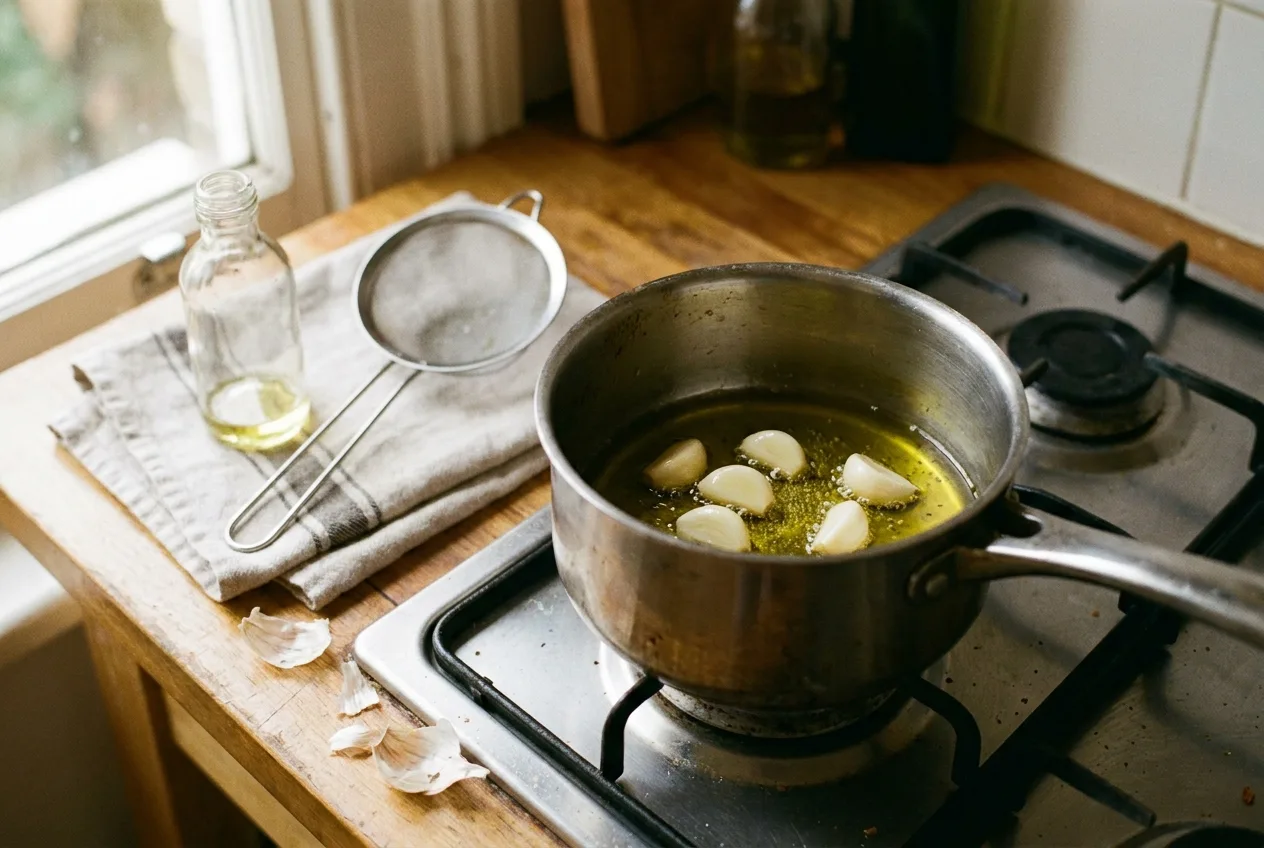
You miss the taste, don't you? That savoury base note that onion and garlic add to almost everything. The good news is you can have most of it back, and the reason is simpler than you'd think.
The part of onion and garlic that gives many people with a J-pouch grief is a carb called fructans (a sugar chain that ferments quickly in the gut and makes wind). Here's the useful bit: fructans don't dissolve in oil. They're water-soluble. So when you cook onion or garlic in oil and then take the solids out, the flavour comes across but the fructans stay behind in the bits you discard.
That's the whole trick. It's also one of the biggest single things you can do to bring a dish's score down without giving up flavour.
Why oil works and water doesn't
Flavour compounds in garlic and onion are mostly oil-loving. Fructans are water-loving. Two different teams.
When you simmer garlic in olive oil, the oil pulls out the aromatic, sulphur-y flavour molecules. The fructans don't follow. Strain out the garlic and you've got garlic-flavoured oil with very little of the carb that troubles you.
The evidence here is solid for the chemistry. How much your own gut tolerates is the part only you can test, so go gently the first time.
What about caramelised onion?
This comes up a lot, so it's worth answering plainly. Cooking onion low and slow in oil does pull some flavour into the oil, but here's the catch: you eat the onion too. And the fructans are still sitting right there in the soft, sweet pieces on your plate.
Cooking doesn't break fructans down much. Long, slow heat shifts the flavour and softens the texture, but it doesn't remove the carb the way straining does. So caramelised onion is gentler than a pile of raw onion for some people, mostly because the portion ends up small and the harsh edge is gone — but it's not in the same league as infused oil, where you throw the solids away entirely.
A middle path some people like: caramelise the onion, then lift the pieces out and keep just the oniony oil. You lose the jammy texture, but you get the flavour without eating the fructans.
Raw, sautéed or strained — roughly how they stack up
| How it's prepared | Fructans you actually eat |
|---|---|
| Raw onion or garlic | Highest — all of it stays |
| Sautéed or caramelised (eaten whole) | About the same — cooking doesn't remove much |
| Cooked in oil, solids strained out | Lowest — the carb stays in the bits you discard |
So if your goal is fewer fructans, the strain is what does the work, not the cooking.
Garlic-infused oil, step by step
This is the one I'd start with. It keeps for about a week in the fridge.
- Peel and roughly bash 3-4 cloves of garlic so the cut surfaces are exposed.
- Warm about 250ml of olive oil in a small pan over low heat.
- Add the garlic. Keep it gentle — you want it to sizzle softly, not fry hard. Around 5-10 minutes.
- When the garlic turns pale gold and the oil smells of garlic, take it off the heat.
- Let it cool, then lift out and throw away every piece of garlic. This matters for safety (more below).
- Strain the oil through a fine sieve into a clean jar. Fridge it.
For onion, do the same with a few thick slices of onion or the green tops of spring onion. The green tops are already lower in fructans, so that's a nice double win.
The botulism note — please don't skip this
Garlic in oil can grow Clostridium botulinum, the bacteria behind botulism. It's rare, but it's serious. The bug likes low-oxygen, low-acid conditions, and oil with raw garlic sitting in it is exactly that.
This is also why the strained, fridged oil is the version I'd reach for over keeping caramelised onion in oil on the bench. The oil you make and use within a week, kept cold, is the careful option. Anything left sitting at room temperature with bits of garlic or onion in it is where the risk creeps in.
A few rules keep you well clear:
- Don't store homemade garlic oil at room temperature. Make it, cool it, fridge it.
- Use it within about a week. Label the jar with the date.
- Remove all the solid garlic and onion before storing. Don't leave cloves sitting in the oil.
- If you want oil that keeps for months, buy a commercial infused oil — the reputable ones are acidified or made to be shelf-stable safely.
None of this is meant to scare you off. It's a simple food, made properly. Treat it like fresh pesto, not like a pantry staple.
How to actually use it
Once you've got a jar, it goes almost anywhere onion and garlic would:
- Drizzled over roast sweet potato or courgette before they go in the oven.
- As the fat you start a risotto or fried rice in.
- Whisked into a salad dressing with a little vinegar and mustard.
- Brushed over toast, or tossed through plain pasta with parmesan.
A little goes a long way. Start with a teaspoon and build up.
A few other low-fructan flavour tricks
Infused oil isn't your only move. You could also try:
- Green spring onion tops and chives — the green parts are gentler than the white bulb for most people.
- Garlic-infused stocks, then discard the solids, same idea as the oil.
- Asafoetida (hing), a pinch fried in oil. It gives a surprisingly onion-y savouriness and is naturally low in fructans, though check the blend isn't bulked out with wheat flour.
For where onion and garlic sit on our scoring, see onion and garlic, and if you want the reasoning behind the numbers, how the scores work lays it out.
Reintroduce one thing at a time, and keep the portion small to begin with. Everyone's gut draws the line in a slightly different place — this just moves the line in your favour.